Before the Box Becomes Infrastructure
The smart home’s next fight is not about gadgets. It is about who owns the operational record of the house.

The leak starts under the water heater at 2:13 a.m. Nobody hears it. By morning, the water has found the drywall, the baseboard, and the part of the homeowner’s soul reserved for insurance deductibles.
A small box near the utility room could notice first. It could send an alert, prevent damage, and give a contractor useful information before anyone crawls into the attic or opens a panel.
That is the promise of predictive home monitoring. It is a real promise. I have worked in HVAC contracting and understand control systems. Better monitoring can save money, prevent damage, and help contractors do better work. Nobody needs to pretend ignorance is a civil liberty.
The problem is not the alert. The problem is the record.
A home is not a phone. A phone is an object you carry. A home, whether rented or owned, is shelter, family archive, financial instrument, utility endpoint, maintenance burden, and legal address. Turning that place into a continuous data environment is not the same as adding another app.
Who owns that data?
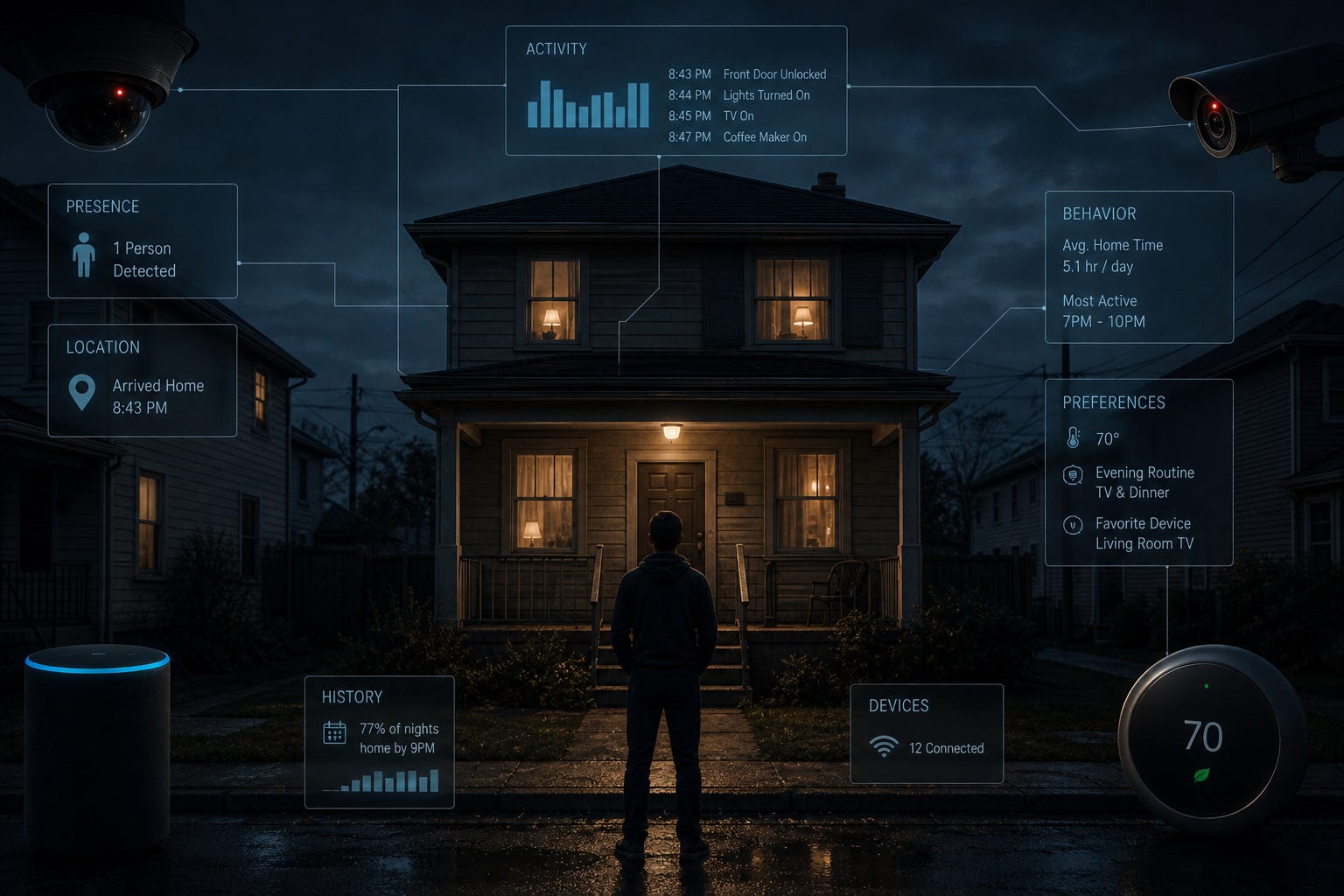
One company shows why this category deserves attention.
HG Home Guardian, a Southern California home-services company, advertises its patented product as “the first-of-its-kind smart home monitoring system delivering real-time data and powerful analytics to give you unparalleled insight into your home’s critical systems, all in one easy to use platform.”1
Recent promotional materials describe a home operating system with data intelligence and ecosystem layers connecting insurance, utilities, contractors, and property managers. Later, it puts the platform economics more bluntly: the real scale comes “not from selling devices” but from “owning the data layer of the home.”2
The platform economics are stated bluntly: the real scale comes “not from selling devices” but from “owning the data layer of the home.”
Please pause there, because “owning the data layer of the home” is doing the kind of work usually reserved for a zoning board, a mortgage servicer, and the guy at the permit counter who has never smiled.
In another public post, the company’s founder describes the product as “the system of record for the home,” “a data acquisition and retention platform embedded directly into the home,” and, again, “the data backbone for insurance, utilities, and warranty providers.”3
A later Home Guardian pitch attributed to HVACGOD (Keith E. Flores), Chamath Palihapitiya, and David Sacks makes the business model unusually clear. It describes the home as a live data environment and presents the business opportunity as moving home services from reactive service calls to continuous monitoring, predictive intervention, and a persistent relationship between contractor and homeowner. It also describes Home Guardian as “the data + retention infrastructure layer,” says that layer drives increased lifetime value, reduced churn, predictable recurring revenue, cross-trade expansion opportunities, and points toward “a massive proprietary dataset on how homes actually perform.”4
That is the moment the furnace acquires a LinkedIn profile.
The public attribution is notable context, not an indictment. A product being publicly described as infrastructure deserves scrutiny when that description is attached to people fluent in venture markets and technology policy. Sacks recently served as the White House special advisor for AI and crypto before moving into an advisory role as co-chair of the President’s Council of Advisors on Science and Technology.5
It’s important to note that this is not a hidden conspiracy. It is a business model. It is also not inherently absurd. Flores built Home Guardian from thirty-five years in the trades. The problem he is trying to solve is real. The question is whether the company that gets there first will shape the governance framework or wait for someone else to impose it. A platform that chooses transparency, portability, and genuine homeowner control before any required regulation would be building something more durable than a data layer. It would be building trust. That choice belongs to the people building it, and it is still available to make.
To HVACGOD’s credit, a public answer points in the right direction: homeowner data ownership, limited contractor access, encrypted communication, authentication controls, and system isolation.6 Those are important design commitments. However, Home Guardian’s privacy policy is broader than the public assurances.
The Privacy Policy Problem
Last updated February 12, 2026, the policy is prefaced with “With your permission, or as the law allows, we collect different kinds of personal information, which we call “Personal Information” in this Privacy Policy.” The important part is not “with your permission.” It is the second door: “or as the law allows.” That means consent is only one pathway. They are also reserving the right to collect personal information when another legal basis permits it.7
Collection categories are also defined very broadly. HG’s installed Device “actively collects Personal Information,” continuously sends it to HG’s servers, and uses it not only for home monitoring services but also for internal reporting, “HG’s third-party usage,” marketing purposes, and other purposes allowed by the policy. It separately defines “Home/Real Property Data” to include location data, energy, gas, water and other utility usage, utility costs, and the performance and energy usage of appliances and other home equipment. It also includes sensitive information, such as racial or ethnic origin, religious or philosophical belief, and sexual orientation, along with inferences used to create profiles reflecting preferences, behavior, and attitude.7
This does not prove misuse, but breadth matters, and is the difference between “we watch your sump pump” and “please enjoy our flexible legal container for domestic telemetry.”
Then there is the patent record, which takes the whole situation out of the soft upholstered room of marketing copy and places it under fluorescent light.
The Patent Problem
HG Home Guardian’s granted patent US12130031B2 describes a centralized home-monitoring system built around sensors, environmental data, and a central station. The central station can determine conditions of utility devices, manipulate at least one utility device, and make recommendations based on operation data, environment data, and the behaviors of at least one occupant. The patent’s protected system reaches across HVAC, air quality, water systems, water treatment, safety-threat detection, machine-learning energy optimization, maintenance planning, and transmission of stored operation and environment data to an external device. It also includes a claim for determining “illegal activity or hazardous activity” based on operation and environment sensor data.8
The patent specification is even more explicit about the imagined sensor world. It describes, among other examples, electrical pattern monitoring for grow lights and heavy HVAC use, RF signal detection for unauthorized electronics, gas chromatography sensors for traces associated with marijuana or meth manufacturing chemicals, and optical detection of grow-lamp signatures, including those concealed by walls.8
The pending continuation application appears to widen that architecture. It uses the same underlying description but reorganizes the claims around a broader category: “undesirable events.” In that version, the central station determines whether an undesirable event exists and manipulates utility devices to remedy or eliminate it. Later claims define undesirable events to include safety threats, air contamination, water leaks or failures, and illegal activity.9
The patent does not prove that Home Guardian is currently detecting illegal activity inside homes, and this piece does not assert that.
It does show that the company has sought and received protection for a centralized home-monitoring architecture that can classify certain activity as illegal or hazardous based on sensor data.
That matters because when a product is being pitched as a home operating system and data backbone for institutional actors, it should be judged not only by today’s dashboard, but by the institutional uses its architecture invites.
*I contacted HG Home Guardian for comment before publication. The company did not respond to the request.
The box does not have to be sinister to become structural.
Nobody has to force the box into every house; the easier path is incentives. First, it saves you money. Then it improves your claim. Then it documents your maintenance. Then your landlord wants the report. Then your insurer asks why you do not have one. Then the contractor’s best service tier assumes it.
Every step can be defended. Each has a PowerPoint slide with clean fonts. Together, they create a world where opting out remains technically possible in the same way you are technically free to argue with a rental portal at 11:47 p.m.
At no point does anyone kick down the door. The door simply becomes harder to close.
Adjacent incentives and precedents already exist.
Home insurers have long offered discounts for risk-reducing devices such as monitored alarms, smart security systems, water sensors, and leak-detection devices.16 American Family, for example, describes a smart-home discount for qualifying smart home devices or security systems.17 Farmers says leak monitoring and water-flow shutoff devices may earn a significant home-insurance discount, and notes that in some locations they are required when Farmers insures homes with older plumbing.18 That is not the same thing as requiring a continuous operational feed from the entire house, but it shows the direction of the incentive structure: when a device reduces measurable risk, third parties begin to reward, request, or in narrower cases require its use.
There are already more specific examples of monitoring becoming an underwriting condition in certain contexts. A 2026 high-value home insurance document from The Philadelphia Contributionship states that some policyholders must provide certification of central station fire alarms, central station burglar alarms, and inline water shutoff, with documentation added to the underwriting file at binding and cancellation possible if documentation is not provided within the stated window.19 This is not a general rule for ordinary homes, but it is a narrow precedent showing how protective devices can move from optional risk reduction to documented insurability requirements when value, risk, or underwriting context changes.
Documentation provides another bridge. HVAC warranties, home warranties, and insurance claims already rely on maintenance records, service receipts, installation details, and proof that systems were properly maintained. Lennox warranty language, for example, notes that proof of prior maintenance and purchase may be required.20
The data is tempting to everyone.
Tempting to insurers, because operational data can sharpen risk pricing.
Tempting to utilities, because homes can become flexible demand nodes.
Tempting to warranty providers, because maintenance compliance can be documented or disputed.
Tempting to landlords, because system-health records can become tenant-management tools.
Tempting to lenders and buyers, because home performance can become part of valuation.
Tempting to contractors, because continuous monitoring can turn emergency customers into recurring accounts.
Tempting to platforms, because once enough parties depend on the record, the record becomes leverage.
The larger market context is also speaking volumes. Residential services are being consolidated into larger platforms built around recurring demand, membership programs, technician networks, and customer records.
Trends in Private Capital
Private capital has noticed the stability of HVAC, plumbing, and electrical services, and has been moving into residential services platforms. General Atlantic invested in Flint Group, a home-services company providing HVAC, plumbing, and electrical services, with the stated goal of building a leading national platform.10 Morgan Stanley Capital Partners bought Sila in 2021 and later agreed to sell it to Goldman Sachs Alternatives; Reuters reported that the deal valued Sila at about $1.5 billion including debt.11, 12 In 2026, Reuters reported that American Residential Services was exploring a sale that could value the company at more than $3.5 billion, citing strong private-equity interest in residential services because of stability and recurring demand.13 Blackstone’s agreement to acquire Champions Group, a residential services platform with more than 1,800 field technicians and 150,000 active members, points in the same direction.14
Quy Ma’s recent field guide offers valuable language for naming what is forming here.15 This is not just surveillance capitalism, though it begins there, since a home-monitoring platform would be extracting behavioral and operational data from the home. It becomes predictive capitalism when that data is used to anticipate failures, price risk, schedule service, shape maintenance behavior, and reorganize contractor response before the homeowner fully understands the need. It becomes platform capitalism when homeowners, contractors, insurers, utilities, landlords, lenders, and manufacturers begin coordinating through the same private layer. It becomes rentier capitalism if access to preferred pricing, warranties, contractor networks, insurance treatment, or compliance status depends on passing through that platform’s gate.
Home data enables prediction; prediction enables service; service creates dependence; and dependence can turn a consumer device into public infrastructure.
Please imagine a symposium panel titled “Your Toilet as an Asset Class.” The key finding is that the homeowner experiences less friction on the surface while the friction migrates elsewhere. Fewer surprise failures. Easier scheduling. Better energy use. Clearer maintenance reminders. Then: subscription dependence, insurance scoring, contractor lock-in, opaque maintenance standards, data-sharing pressure, and practical penalties for opting out.
The support ticket becomes the property record.
Current law is not built cleanly for this. General privacy laws provide useful tools, but not a full answer. California’s privacy law gives residents rights to know, delete, correct, opt out of sale or sharing, limit certain uses of sensitive personal information, and avoid discrimination for exercising those rights. California also defines personal information to include information that could reasonably be linked with a household.21 More broadly, comprehensive U.S. state privacy laws commonly give qualified rights to access, correct, delete, and opt out of certain sales, sharing, targeted advertising, or profiling.22
Meanwhile, policy is already normalizing some of the pieces that make a home operating layer legible as infrastructure. The FCC’s U.S. Cyber Trust Mark is a voluntary cybersecurity labeling program for consumer wireless Internet of Things products, intended to help consumers identify devices meeting baseline cybersecurity standards.23 In April 2026, the FCC selected the ioXt Alliance as the new Lead Administrator for the program.24
That may be good consumer protection. It also helps create a trusted market for connected home devices.
This is the bureaucratic comedy of the age: the state does not have to mandate the platform. It can help standardize the conditions under which the platform becomes the obvious solution.
Energy policy moves in the same direction. The Department of Energy describes smart thermostats as devices that analyze temperature and occupancy data, learn occupant schedules and building thermal response, use weather forecasts, and support demand response and time-variable pricing.25 ENERGY STAR’s smart thermostat criteria require certified devices to work as basic thermostats without connectivity, provide residents feedback and HVAC energy-use information, and work with utility programs to help prevent brownouts and blackouts while preserving consumer override.26
Again, none of that is bad by itself. Grid flexibility is real. Energy efficiency is real. Cybersecurity labels are better than a smart toaster with the threat model of a wet napkin. The problem is convergence. Homes become more measurable, more responsive, more predictable, more connected, and more governable by software. Then a private company shows up with a pitch for the operating system.
The FTC can act when companies violate privacy rights, mislead consumers by failing to maintain security for sensitive information, or cause substantial consumer injury.27 The FTC has also reopened rulemaking around negative-option practices, including concerns about misleading disclosures, billing without consent, and cancellation barriers.28
These regulatory tools were not designed around the full weirdness of a house that generates operational telemetry.
This is not a story about one company so much as it is about the category. A home is not only a machine, but also a legal status, a financial instrument, a maintenance burden, a family address, a rental unit, a utility endpoint, and a jurisdictional headache.
Home is also a place where people have historically been allowed to close the door.
Home operational data should be treated as a protected category before the platform becomes unavoidable. The rules do not need to be complicated; they need to arrive before the market hardens.
Home data should belong first to the resident or homeowner
Sharing should be opt-in, separate, revocable, and readable.
Essential services should not require a live operational feed.
Contractors should not become captive endpoints of a private platform. Liability should follow control.
The digital history of a home should be portable when the home is sold.
The core principle is simple: a home is not merely a data asset because it contains measurable systems.
The right to maintain a home should not become conditional on surrendering the home’s operational data.
A final question concerns digital encumbrance. If this infrastructure becomes proprietary, who owns the digital twin of the home when the house is sold? The buyer receives the roof, the walls, the furnace, the wiring, and the pipes. But who receives the accumulated model of how those systems behave, fail, recover, and impose risk?
If that data stays with the platform, then the house has been split in two: the property someone owns, and the operational intelligence someone else controls.
Predictive home monitoring is genuinely useful. That is exactly why rules need to come first. Once the box is useful enough, the debate will no longer be about whether people want it. It will be about whether people can afford not to have it.
Before that threshold, it is a product choice.
After that threshold, it is infrastructure governance.
And once it becomes infrastructure, the central question is not merely what the system can see. It is who controls the record, who writes the rules, who bears the friction, and who pays the fee.
Citations
HG Home Guardian, homepage/product description, accessed April 27, 2026.
HVACGOD and David Sacks, “The Smart Home Industry Has It Wrong,” HVACGOD’s Newsletter, March 25, 2026. https://hvacgod.substack.com/p/the-smart-home-industry-has-it-wrong
HVACGOD Inc., LinkedIn showcase page, post excerpt beginning “The $1T home services market is being consolidated,” accessed May 2, 2026. https://www.linkedin.com/posts/keith-e-flores-13a33147_homeguardian-proptech-privateequity-activity-7455322086849531904-oxSW?utm_source=social_share_send&utm_medium=member_desktop_web&rcm=ACoAADq6WMUBrP5-dKQx6Lh3WnNAPbMS2fC4PV0
HVACGOD, Chamath Palihapitiya, and David Sacks, “The Missing Layer in the $1T Home Services Market,” HVACGOD’s Newsletter, April 29, 2026. The Missing Layer in the $1T Home Services Market
Trevor Hunnicutt and Krystal Hu, “White House AI czar Sacks to step down, moves to advisory role,” Reuters, March 27, 2026. https://www.reuters.com/world/us/white-house-ai-czar-sacks-step-down-moves-advisory-role-2026-03-27/
HVACGOD, public answer on Home Guardian data ownership and security, Substack Notes, accessed May 1, 2026. https://substack.com/@hvacgod/note/c-237095691?r=88wtfs&utm_source=notes-share-action&utm_medium=web
HG Home Guardian, “Privacy Policy,” effective July 17, 2025, last updated February 12, 2026. https://www.hghomeguardian.com/privacy-policy/
U.S. Patent No. 12,130,031, “System and method for monitoring a home environment of utility devices,” issued Oct. 29, 2024, assigned to HG Home Guardian Inc. USPTO Patent Public Search.
U.S. Patent Application Publication No. 2025/0283621, “Centralized Home Automation System and Method of Use Thereof,” published Sept. 11, 2025, applicant HG Home Guardian Inc. USPTO Patent Public Search.
General Atlantic, “Flint Group Announces Strategic Partnership With General Atlantic,” August 18, 2023. https://www.generalatlantic.com/media-article/flint-group-announces-strategic-partnership-with-general-atlantic/
Morgan Stanley, “Morgan Stanley Capital Partners Completes Investment in Sila Heating & Air Conditioning,” May 18, 2021. https://www.morganstanley.com/im/en-us/individual-investor/insights/press-release/ms-capital-partners-completes-investment-sila-hvac.html
Reuters, “Morgan Stanley’s PE arm to sell HVAC firm to Goldman Sachs Alternatives,” November 11, 2024. https://www.reuters.com/markets/deals/morgan-stanley-sell-hvac-firm-sila-goldman-sachs-2024-11-11/
Reuters, “American Residential Services explores $3.5 billion-plus sale, sources say,” March 23, 2026. https://www.reuters.com/world/american-residential-services-explores-35-billion-plus-sale-sources-say-2026-03-23/
Blackstone, “Blackstone Announces Agreement to Acquire Champions Group,” February 17, 2026. https://www.blackstone.com/news/press/blackstone-announces-agreement-to-acquire-champions-group/
Quy Ma, “The Twelve Forms of Capitalism: A Field Guide,” Substack Notes, accessed May 1, 2026. https://quyma.substack.com/p/the-twelve-forms-of-capitalism-a
Travelers, “How Smart Home Technology Helps Protect Your Home,” accessed May 1, 2026. https://www.travelers.com/resources/home/smart-home/how-smart-home-technology-helps-protect-your-home
American Family Insurance, “Safe, Secure, Smart Home Discount,” accessed May 1, 2026. https://www.amfam.com/insurance/home/discounts/safe-secure-smart-home-discount
Farmers Insurance, “Home Leak Detection and Shutoff,” accessed May 1, 2026. https://www.farmers.com/leak-detection
The Philadelphia Contributionship, “High Value Home FAQs,” April 2026. https://1752.com/wp-content/uploads/2026/04/High_Value_Home_Chart_026_4.2026.pdf
Lennox, “Lennox Equipment Limited Warranty,” accessed May 1, 2026. https://www.lennox.com/dA/abf9e7ce94/W900008-03.pdf
California Department of Justice, “California Consumer Privacy Act (CCPA),” accessed May 1, 2026. https://oag.ca.gov/privacy/ccpa
DLA Piper, “Data Protection Laws of the World: United States,” accessed May 1, 2026. https://www.dlapiperdataprotection.com/?c=US
Federal Communications Commission, “Cybersecurity Labeling for Internet of Things,” Federal Register, July 30, 2024. https://www.federalregister.gov/documents/2024/07/30/2024-14148/cybersecurity-labeling-for-internet-of-things
Federal Communications Commission, “FCC Selects New Lead Administrator for U.S. Cyber Trust Mark Program,” April 13, 2026. https://docs.fcc.gov/public/attachments/DOC-420764A1.pdf
U.S. Department of Energy, “Simulation-Driven Smart Thermostat Benchmarking,” accessed May 1, 2026. https://www.energy.gov/cmei/buildings/simulation-driven-smart-thermostat-benchmarking
ENERGY STAR, “Smart Thermostats Key Product Criteria,” accessed May 1, 2026. https://www.energystar.gov/products/smart_thermostats/key_product_criteria
Federal Trade Commission, “Privacy and Security Enforcement,” accessed May 1, 2026. https://www.ftc.gov/news-events/topics/protecting-consumer-privacy-security/privacy-security-enforcement
Federal Trade Commission, “FTC Seeks Public Comment in Response to Advance Notice of Proposed Rulemaking Regarding Negative Option Marketing Practices,” March 11, 2026. https://www.ftc.gov/news-events/news/press-releases/2026/03/ftc-seeks-public-comment-response-advance-notice-proposed-rulemaking-regarding-negative-option
Interesting and concerning, that door is getting very hard to close, or to know you left one open at all, and the question about what happens to the digital house data is actually pretty important, thanks for writing this!